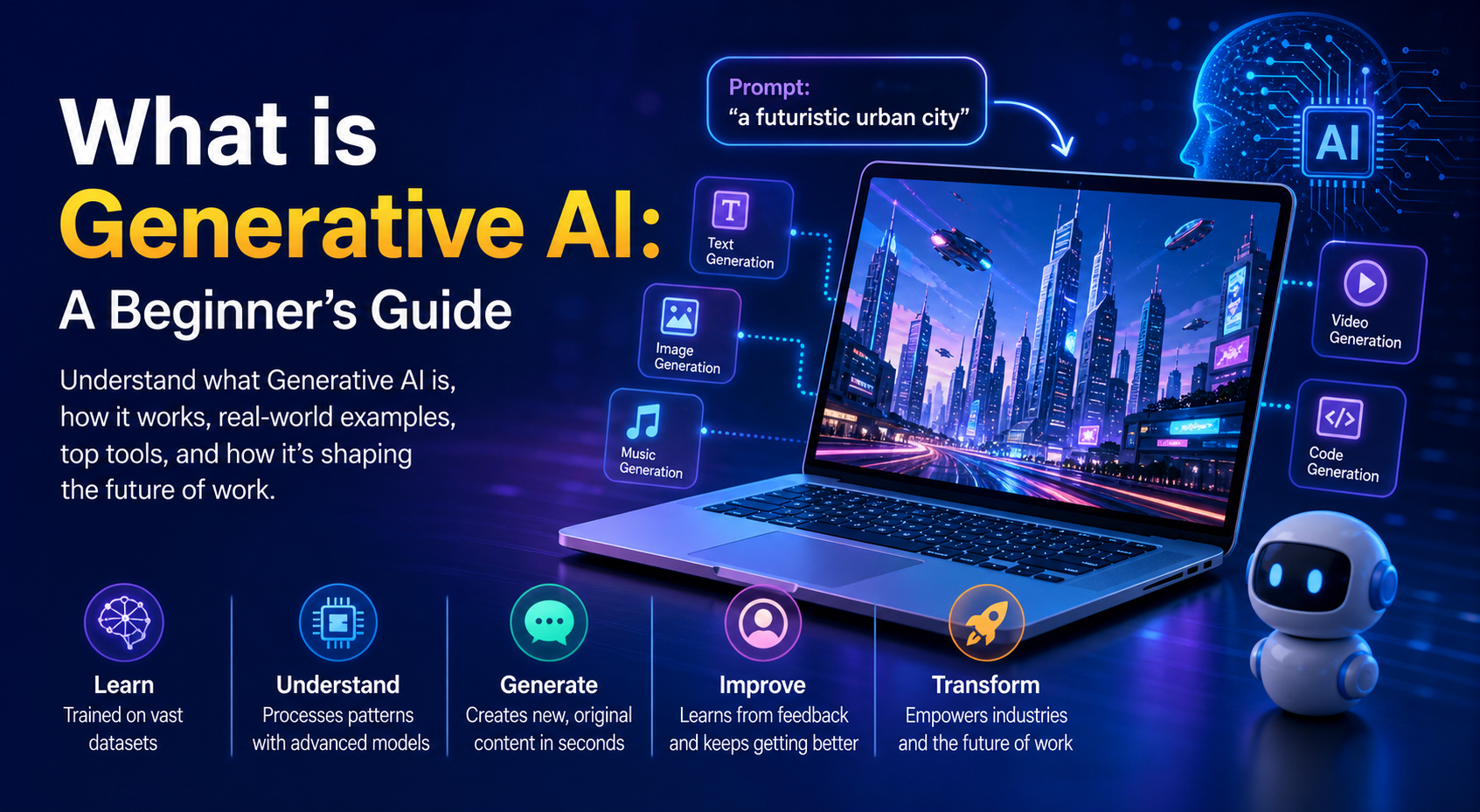
Imagine this: You are a graphic designer, and you just have to give a prompt like “a futuristic urban city”. The tool creates a beautiful picture in front of you, exactly what you had in mind. Sounds familiar, right? That’s Generative AI at work.
Although the practice is not new, not many people are familiar with how exactly it happens behind the scenes. For a professional to leverage the true benefits of this technology, they must understand what it is and how it works. This blog discusses how GenAI can streamline your workflow and the potential it holds in the future.
What is Generative AI?
According to the McKinsey 2025 AI Report, Generative AI is no longer an unusual concept, and its enterprise adoption is rapidly increasing. However, even when the companies are using GenAI, they haven’t been able to move beyond the pilot phase. The reason? They are still unsure about what GenAI is and how it integrates into the existing workflow.
Generative AI, or GenAI, is a form of artificial intelligence used to design new content. It has the ability to create new images, videos, music, and text through user-generated prompts. Unlike how traditional AI works, where the machine analyses and categorises data, Generative AI produces original content based on the datasets it learns from. It delivers new material to mimic human creativity and save a professional’s time and effort.
How Does Generative AI Work?
If you notice, outputs from a Generative AI model may not be able to completely replicate human-generated content. The result mainly depends on the quality of the model and how well it has been equipped with prompts and learning. Once you start training a GenAI tool, here is how it works:
- Data Collection and Learning
GenAI uses a large amount of data to analyse and learn different patterns. They train on that dataset for annotating, so the next time you give it a prompt, you get exactly what you ask for. - Neural Networks and Transformers
The transformer model processes the text and recognises every word. It links those worlds to the images (based on the training) for a coherent creation. - Tokens and Context
Every word in your prompt is broken down into a token that the AI tool processes. Then, it understands the relationship between those words and creates a contextually accurate image. - Feedback Mechanism
Know that in several cases, the image might not match your expectations (depending on the training level). The GenAI will ask for your feedback so it can improve future results. - Reinforcement Learning
The models are rewarded when they generate an accurate result and are pointed out for their mistakes. With the constant feedback and prompts, the GenAI’s ability increases, and it keeps getting more refined.
Generative AI Use Cases
Generative AI offers various services today, from content generation and audio to static graphics and videos. Below are some of the finest examples of how the technology has improved the workflow across industries:
- Anara
The generative AI research assistant makes it easier for users to search and understand scientific papers with authentic AI insights and summaries. Anara leverages Google Cloud’s scalable infrastructure and AI Studio to operate and process data for its global audience. - OpenText Content Aviator
The GenAI assistant improves content research and production capabilities. It is built on the Gemini Enterprise Agent Platform and makes it simple for users to summarise all kinds of enterprise documents. - The Colombian Security Council
The Security Council developed a GenAI chatbot to support its data analysis and management processes. The new-age technology enables quick responses, especially during emergency situations. - Discover Financial
The financial service company has introduced GenAI-enabled virtual assistance, helping customers directly. This agentic customer service also provides information to the agents so they can interact with the global customers more confidently.
Generative AI vs AI: What’s the Difference?
Generative AI is a subset, whereas artificial intelligence is a broader concept that is defined by the concept of making machines more human-like. While AI focuses on performing repetitive tasks, GenAI is capable of producing a range of content, from images and videos to text and music. Below is a clear comparison for your understanding:
| Aspect | Generative AI | Artificial Intelligence |
| Primary Purpose | Generate new content based on historic learning patterns | Analyse data and perform repetitive tasks |
| Examples | Chatbots, image generators | Voice assistants, fraud detection systems |
| Learning Approach | Deep learning models | Rule-based systems |
| Real-World Use Cases | Design generation and synthetic media | Predictive analysis and automation systems |
| Tools Involved | DALL-E, Midjourney, ChatGPT | Traditional ML models |
Popular Generative AI Tools
The purpose of GenAI tools is to simplify your work and save time so you can focus on strategic and core business responsibilities. Below are some of the best choices that you can integrate into your workflow:
- ChatGPT
ChatGPT was one of the first GenAI tools to be introduced to users. Its ability to comprehend your prompts and generate the desired texts without much effort makes it one of the most prevalent tools today.
like “Meet the Younger Self” and “AI Barbie”, have already gone viral. Both indicate how rapidly GenAI is advancing. - Midjourney
As AI adoption is accelerating globally, tools like Midjourney that can build beautiful models are gaining recognition. This image generation tool is purposeful for creating images and videos through text prompts. It also supports motion intensity and video extensions to assist video creators in saving their time. - Claude
Claude is slowly becoming an unbeatable GenAI content writing assistant, as it is known to be more conversational than ChatGPT. It offers straightforward responses and can process a significant amount of data at a given time. One of the best features of Claude is Artifacts, where you can create a budget planner/web app/basic game with a few prompts. - Wix
Wix is known to build effective websites with powerful and intuitive features. All you have to do is answer a few questions about the way you want the website to look, and it will generate a personalised template in no time.
The Future of GenAI: Leading Possibilities for You
What’s important to remember is that technology is not replacing human jobs. Rather, it is changing the way tasks will be assigned and skills will be assessed. With continuous advancement in Generative AI, professionals can only expect that their roles will be more strategically focused and AI-dependent. Companies are actively recruiting freshers who are well-equipped with AI and retaining middle- and upper-level managers who can oversee the performance.